Episodes

  • Who Controls the Story of Power? Islamism & Narrative with Dr Fatemeh Sadeghi | Thinking Islam Ep.14
    Apr 16 2026

    Is political power built on institutions or on the stories we choose to believe?

    What is Islamism, and how do political narratives shape power in the Muslim world?

    In this episode of Thinking Islam, Dr Fatemeh Sadeghi explores Islamism, political narratives, and how storytelling shapes political power and legitimacy. Drawing on both Islamic intellectual traditions and modern social theory, Dr Sadeghi examines how narratives do more than describe reality - they actively shape it. From early Islamic history, where hadith and sīra were used to legitimise authority, to contemporary movements such as Islamism and the far right, we uncover how political stories mobilise people through promises of justice, salvation, and belonging. We also examine the decline of Islamism as a compelling narrative, and the “melancholic condition” it has left behind in many Muslim societies—a space marked by disillusionment, yet still open to new possibilities. The conversation raises a profound question: if all political and even religious commitments are mediated through stories, what kinds of narratives are needed today to sustain hope, dignity, and meaningful collective life?

    Dr Fatemeh Sadeghi is a sociologist and political theorist at the UCL Institute for Global Prosperity. Her research explores political imagination, gender, and the role of narrative in shaping social order and legitimacy, offering a powerful lens for understanding the moral and political crises of our time.

    Audio Chapters:

    00:00 - Highlights

    01:20 - What is a Narrative?

    03:05 - Political Narrative: Stories That Shape Power

    06:39 - Two Kinds of Narratives

    13:19 - Good vs Evil: ‘Us and Them’

    17:17 - Isn’t the Quran doing the same thing?

    23:00 - Nostalgia as a Response to Colonialism

    30:00 - Can some Narratives Cause more ‘Legitimacy’?

    36:10 - Living Through a ‘Melancholic’ Moment

    40:25 - Islamism Moved from Theology to Power

    43:24 - What Comes After Islamism as a New Narrative?

    48:30 - Who Creates Narratives when Knowledge is Democratised?

    56:30 - New ‘Islam’ narratives are still grounded in Morality

    01:00:50 - Thinking Islam Question

    Show more Show less
    1 hr and 3 mins
  • Muslim Rights, Same-Sex Marriage & the Future of Tolerance by Prof. Robert Wintemute | Seminar
    Apr 13 2026

    Can Christian majority societies and Muslim communities find common ground on some of the most contested issues of our time?In this research seminar, Professor Robert Wintemute, Professor of Human Rights Law at King's College London, explores a compelling framework of reciprocal tolerance: if Christian-majority societies continue to legally protect visible Muslim religious practices, can Muslim communities in turn come to accept the secular legal recognition of same-sex marriage?Drawing on landmark case law from the UK, France, Canada, the United States, Germany, and South Africa, Professor Wintemute examines how courts have navigated the tension between institutional neutrality and religious accommodation — from disputes over the niqab and jilbab to the banning of religious symbols in French schools and Québec's public sector. He then turns to the rapid global expansion of same-sex marriage — now legal in 38 countries — and asks what a genuinely pluralistic society might look like when competing rights claims are taken seriously on all sides.Audio Chapters:00:00 Introduction03:12 Majority Acceptance of Visible Muslim Diversity03:24 The Birmingham Case That Changed UK Law10:41 Religious Accommodation in Canada, USA & South Africa13:51 France, Europe & the Secularism Debate24:48 Quebec: Canada's French Exception29:00 Give & Take: Same-Sex Marriage30:08 Criminalisation vs. Recognition Worldwide32:15 Muslim Acceptance of Secular Same-Sex Marriage

    Show more Show less
    36 mins
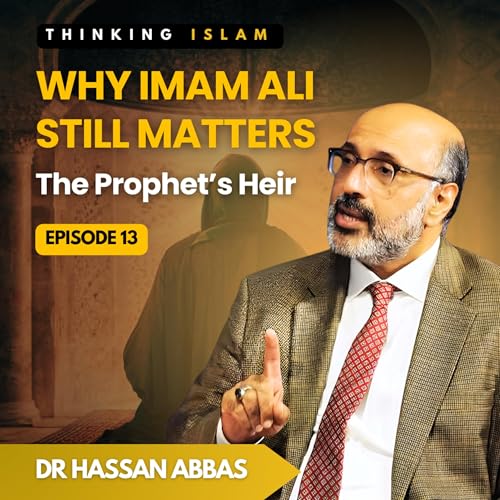
  • Why Imam Ali Still Matters: The Prophet’s Heir with Dr Hassan Abbas | Thinking Islam | Ep.13
    Mar 9 2026

    Is Imam Ali a source of division or the grounds for friendship among Muslims?How did a man who asked that his killer's ropes be loosened in his dying moments become the most contested figure in Islamic history?In this episode of Thinking Islam, we explore Dr Hassan Abbas's acclaimed book, "The Prophet's Heir" through the lens of a policy maker and conflict resolution scholar. Drawing from both Shi'a and Sunni sources, Dr Abbas tells the story of Imam Ali not as a sectarian narrative but as a bridge between traditions. We examine the political dynamics of Saqifa, Ali's radical economic justice, the bias in Western scholarship of Islam, and the paradox of a warrior whose defining qualities were dialogue, selflessness, and forgiveness. In his final moments, struck by a poisoned sword, Ali asked that his killer be treated well, a measure of the justice and forgiveness that Dr Abbas argues makes Ali's legacy not a source of division but a possibility for renewal and unity.Dr Hassan Abbas is Distinguished Professor of International Relations at the National Defence University in Washington, D.C. and a senior adviser at Harvard University's Weatherhead Centre for International Affairs. His research focuses on countering political and religious extremism, rule-of-law reforms, and the intersections of security, politics, and faith in South Asia and the Middle East. "The Prophet's Heir: The Life of Ali ibn Abi Talib," published by Yale University Press, has been widely praised across traditions.Audio Chapters: 0:00 – Highlights 01:32 – Writing a Book on Imam Ali 8:04 – Using Both Shi'a and Sunni Sources 17:23 – The Bias in Western Scholarship 25:35 – An Uncritical Version of Imam Ali? 32:00 – Saqifa Through the Lens of a Policy Maker 43:47 – Did the Companions Fail the Test? 51:28 – Imam Ali as a Diplomat 56:45 – Imam Ali & Economic Justice 1:07:15 – Imam Ali, Dialogue & Egalitarianism 1:16:02 – Imam Ali's Legacy 1:21:05 – Thinking Islam Question

    Show more Show less
    1 hr and 24 mins
  • Rumi and the Pure Heart: Reading the Qur’an Existentially with Dr Soroush | Thinking Islam | Ep.12
    Feb 20 2026

    How does listening to the Qur'an differ from reading it? What does it mean to approach the Qur'an not with your mind but with your whole existence?In this episode of Thinking Islam, Dr Abdolkarim Soroush proposes an existential encounter with the Qur'an, one that asks us to set aside our assumptions and approach it not as a book of law or philosophy but as maw'iẓa (admonition) that speaks to the whole being. This conversation explores the difference between reading and listening, why Rumi's Mathnawi is called the Persian Qur'an, and what it means to have a pure heart as a precondition for understanding the Qur’an. We delve into how kufr in the Qur'an is not about non-belief but about arrogance before truth, and why, as Dr Soroush tells us, the companion according to Sufis is everything.Dr Abdolkarim Soroush is a distinguished philosopher of religion and a leading voice in Islamic intellectual reform. A Visiting Scholar at the University of Maryland and former Professor at the University of Tehran, he has held visiting positions at Harvard, Princeton, and Yale Universities. Dr Soroush is renowned for his influential work on prophetic experience and his contributions to contemporary Islamic philosophy and Qur'anic hermeneutics.

    Audio Chapters:

    0:00 - Highlights

    01:30 - Relation between Qur’an & Its Reader

    07:20 - Uneven depth of the Qur’an

    13:09 - Reading vs Listening to Qur’an

    24:44 - Existential Reading of the Qur’an

    32:36 - Losing the Sense of Maw’iza in Translation

    39:33 - Rumi’s Mathnawi: A Persian Qur’an

    44:50 - Pure Heart & Qur’an

    49:17 - Love & Companionship

    55:19 - Is Qur’an not a Kitab?

    58:32 - Thinking Islam Question

    Show more Show less
    1 hr and 1 min
  • A People's History of Islam: Tales of Mystics, Pilgrims and the Ordinary by Dr Hassan Abbas
    Jan 26 2026

    Who writes Islamic history — empires and rulers, or ordinary believers?In this research seminar hosted by AMI on 14 January 2026, Dr Hassan Abbas presents insights from his forthcoming book project, A People’s History of Islam. Challenging state-centred and court-sponsored historiography, Dr Abbas explores Islam through the lived faith of pilgrims, mystics, poets, and everyday communities across centuries.Drawing on extensive travels to major pilgrimage sites — from Fez, Konya, and Baku to Lahore, Karbala, and Makkah — the seminar highlights how oral tradition, spirituality, and devotion preserve histories often absent from official archives. Dr Abbas also reflects on the role of mysticism alongside juridical tradition, the challenge of writing accessible yet rigorous scholarship, and the problem of sectarian framing in Western representations of Islam.Speaker:Dr Hassan Abbas is a Distinguished Professor of International Relations based in Washington, DC, and a Senior Advisor at Harvard University’s Project on Shi'ism and Global Affairs. He is the author of The Prophet’s Heir (Yale University Press) and several other widely cited works on Islam and global affairs.

    Show more Show less
    41 mins
  • Why Are Shi‘as Still Mourning? Death, Muharram & Senses with Dr Babak Rahimi | Thinking Islam Ep. 11
    Jan 15 2026

    Can mourning become a pathway to the divine?

    Has the modern world sanitised death, and does Muharram insist we don’t look away?

    Drawing from his forthcoming book Senses of Mourning, Dr Babak Rahimi of UC San Diego asks a question many have wondered, but few have explored: why do Shi'as keep mourning? This episode reveals mourning not as passive grief but as active devotion, a technique for connecting to God through the body, the senses, and collective memory. We explore how modernity's devotion to pleasure has pushed death to the margins, how Muharram insists we confront what modern life conceals, and why the senses are not obstacles to the sacred but pathways toward it. From the festive dimensions of grief to the standardisation of ritual by state and digital platforms, this conversation moves through the space where philosophy meets performance, and where the body becomes a site of hope.

    Dr Babak Rahimi is an Associate Professor of Communication, Culture and Religion at UC San Diego, where he directs the Program for the Study of Religion and the Middle East Studies Program. His research focuses on sensory religion, public sphere theory, and the historical contexts of early modern Islamicate societies. He is the author of "Theatre-State" and "The Formation of the Early Modern Public Sphere in Iran" (Brill, 2011) and editor of "Performing Iran" (I.B. Tauris, 2021).

    Audio Chapters:

    0:00 – Highlights

    01:30 – Why Muharram Performances?

    5:50 – Mourning as Religiosity?

    18:06 – Mourning as Technique

    26:02 – Muharram as Festive Events

    36:01 – Role of Senses in Muharram Devotion

    46:14 – Panja and Symbolism

    51:00 – Memory as a Sense?

    57:00 – Gender and Muharram Performances

    59:50 – Self-Flagellation as Performance?

    1:06:40 – Muharram and the Other

    1:11:00 – Why Western Thinkers?

    1:19:40 – Modern World and the Sense of Smell

    1:24:27 – Digital and the Standardisation of Muharram Rituals

    1:38:28 – Thinking Islam Question


    📖 Get the Book: "Senses of Mourning" by Dr. Babak Rahimi

    🔗 Penn Press: https://www.pennpress.org/9781512828344/senses-of-mourning/

    🔗 Amazon UK: https://www.amazon.co.uk/Senses-Mourning-Moharram-Performances-Qajar/dp/1512828343

    Show more Show less
    1 hr and 41 mins
  • Digital Spiritualism: A New Meaning to Religious Secularism in India by Dr Zairu Nisha
    Dec 31 2025

    Dr Nisha explores how digital technologies are reshaping religious life in contemporary India. Challenging the strict divide between the secular and the religious, she argues that digital media has given rise to new hybrid forms of belief, practice, and spiritual experience.

    Show more Show less
    18 mins
  • Techno-Gnosticism for the Digital Age: AI, Transhumanism, and the Flight from Embodiment by Professor Michal Valčo
    Dec 31 2025

    This talk critically examines transhumanism and AI through the lens of Christian theological anthropology. Professor Valčo contrasts visions of technological “optimization” with religious understandings of embodiment, vulnerability, and communion, offering an alternative ethical vision for the digital future.

    Show more Show less
    22 mins