The AMI Podcast Podcast By Al-Mahdi Institute cover art

The AMI Podcast

The AMI Podcast

By: Al-Mahdi Institute
Listen for free

AMI Podcasts explore a range of different topics including the latest cutting-edge research within the field of Islamic Studies, book reviews by prominent authors and academics, and discussions among scholars of diverse faiths and denominations within Islam.Al-Mahdi Institute Islam Spirituality
Episodes
  • Who Controls the Story of Power? Islamism & Narrative with Dr Fatemeh Sadeghi | Thinking Islam Ep.14
    Apr 16 2026

    Is political power built on institutions or on the stories we choose to believe?

    What is Islamism, and how do political narratives shape power in the Muslim world?

    In this episode of Thinking Islam, Dr Fatemeh Sadeghi explores Islamism, political narratives, and how storytelling shapes political power and legitimacy. Drawing on both Islamic intellectual traditions and modern social theory, Dr Sadeghi examines how narratives do more than describe reality - they actively shape it. From early Islamic history, where hadith and sīra were used to legitimise authority, to contemporary movements such as Islamism and the far right, we uncover how political stories mobilise people through promises of justice, salvation, and belonging. We also examine the decline of Islamism as a compelling narrative, and the “melancholic condition” it has left behind in many Muslim societies—a space marked by disillusionment, yet still open to new possibilities. The conversation raises a profound question: if all political and even religious commitments are mediated through stories, what kinds of narratives are needed today to sustain hope, dignity, and meaningful collective life?

    Dr Fatemeh Sadeghi is a sociologist and political theorist at the UCL Institute for Global Prosperity. Her research explores political imagination, gender, and the role of narrative in shaping social order and legitimacy, offering a powerful lens for understanding the moral and political crises of our time.

    Audio Chapters:

    00:00 - Highlights

    01:20 - What is a Narrative?

    03:05 - Political Narrative: Stories That Shape Power

    06:39 - Two Kinds of Narratives

    13:19 - Good vs Evil: ‘Us and Them’

    17:17 - Isn’t the Quran doing the same thing?

    23:00 - Nostalgia as a Response to Colonialism

    30:00 - Can some Narratives Cause more ‘Legitimacy’?

    36:10 - Living Through a ‘Melancholic’ Moment

    40:25 - Islamism Moved from Theology to Power

    43:24 - What Comes After Islamism as a New Narrative?

    48:30 - Who Creates Narratives when Knowledge is Democratised?

    56:30 - New ‘Islam’ narratives are still grounded in Morality

    01:00:50 - Thinking Islam Question

    Show more Show less
    1 hr and 3 mins
  • Muslim Rights, Same-Sex Marriage & the Future of Tolerance by Prof. Robert Wintemute | Seminar
    Apr 13 2026

    Can Christian majority societies and Muslim communities find common ground on some of the most contested issues of our time?In this research seminar, Professor Robert Wintemute, Professor of Human Rights Law at King's College London, explores a compelling framework of reciprocal tolerance: if Christian-majority societies continue to legally protect visible Muslim religious practices, can Muslim communities in turn come to accept the secular legal recognition of same-sex marriage?Drawing on landmark case law from the UK, France, Canada, the United States, Germany, and South Africa, Professor Wintemute examines how courts have navigated the tension between institutional neutrality and religious accommodation — from disputes over the niqab and jilbab to the banning of religious symbols in French schools and Québec's public sector. He then turns to the rapid global expansion of same-sex marriage — now legal in 38 countries — and asks what a genuinely pluralistic society might look like when competing rights claims are taken seriously on all sides.Audio Chapters:00:00 Introduction03:12 Majority Acceptance of Visible Muslim Diversity03:24 The Birmingham Case That Changed UK Law10:41 Religious Accommodation in Canada, USA & South Africa13:51 France, Europe & the Secularism Debate24:48 Quebec: Canada's French Exception29:00 Give & Take: Same-Sex Marriage30:08 Criminalisation vs. Recognition Worldwide32:15 Muslim Acceptance of Secular Same-Sex Marriage

    Show more Show less
    36 mins
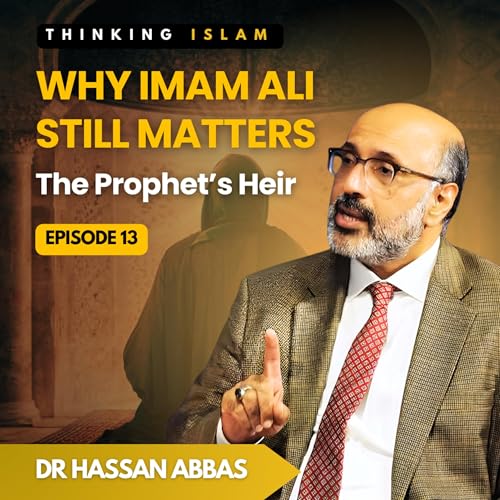
  • Why Imam Ali Still Matters: The Prophet’s Heir with Dr Hassan Abbas | Thinking Islam | Ep.13
    Mar 9 2026

    Is Imam Ali a source of division or the grounds for friendship among Muslims?How did a man who asked that his killer's ropes be loosened in his dying moments become the most contested figure in Islamic history?In this episode of Thinking Islam, we explore Dr Hassan Abbas's acclaimed book, "The Prophet's Heir" through the lens of a policy maker and conflict resolution scholar. Drawing from both Shi'a and Sunni sources, Dr Abbas tells the story of Imam Ali not as a sectarian narrative but as a bridge between traditions. We examine the political dynamics of Saqifa, Ali's radical economic justice, the bias in Western scholarship of Islam, and the paradox of a warrior whose defining qualities were dialogue, selflessness, and forgiveness. In his final moments, struck by a poisoned sword, Ali asked that his killer be treated well, a measure of the justice and forgiveness that Dr Abbas argues makes Ali's legacy not a source of division but a possibility for renewal and unity.Dr Hassan Abbas is Distinguished Professor of International Relations at the National Defence University in Washington, D.C. and a senior adviser at Harvard University's Weatherhead Centre for International Affairs. His research focuses on countering political and religious extremism, rule-of-law reforms, and the intersections of security, politics, and faith in South Asia and the Middle East. "The Prophet's Heir: The Life of Ali ibn Abi Talib," published by Yale University Press, has been widely praised across traditions.Audio Chapters: 0:00 – Highlights 01:32 – Writing a Book on Imam Ali 8:04 – Using Both Shi'a and Sunni Sources 17:23 – The Bias in Western Scholarship 25:35 – An Uncritical Version of Imam Ali? 32:00 – Saqifa Through the Lens of a Policy Maker 43:47 – Did the Companions Fail the Test? 51:28 – Imam Ali as a Diplomat 56:45 – Imam Ali & Economic Justice 1:07:15 – Imam Ali, Dialogue & Egalitarianism 1:16:02 – Imam Ali's Legacy 1:21:05 – Thinking Islam Question

    Show more Show less
    1 hr and 24 mins
No reviews yet