Episodes

  • Trump vs. The Pope! The Scandal That Threatens Democratic Fundraising (with Kevin Ryan and Dave Levinthal)
    Apr 16 2026

    Israel and Lebanon have agreed to a ceasefire after talks in Washington, with President Donald Trump saying it would take effect at 5 p.m. Eastern time on Thursday. He said he spoke with Israeli Prime Minister Benjamin Netanyahu and Lebanese President Joseph Aoun, and plans to bring both to the White House for what he called a major step in relations between the two countries.

    The agreement is supposed to set up a longer-term framework for stability along the border and touch on broader security issues in the region. But it’s landing in a situation where fighting, pressure, and political signaling are all still active in the background.

    Trump also floated the idea that this could connect to a wider regional deal, including Lebanon’s relationship with Hezbollah, the Iran-backed group that plays a major role inside the country.

    That ties into the bigger question hanging over all of this: Iran. U.S.–Iran talks recently fell apart without a deal, though the White House is still leaving the door open to more negotiations. Nothing is settled there, but it sits underneath almost every other move in the region.

    Politics Politics Politics is a reader-supported publication. To receive new posts and support my work, consider becoming a free or paid subscriber.

    In Washington, there’s a pretty straightforward way this is being read. Hezbollah’s strength in Lebanon is tightly linked to Iranian support. If that support weakens, the balance in the region shifts. If it doesn’t, then agreements like this stay limited in what they can actually change.

    At the same time, Trump has been talking about possible Supreme Court vacancies and new nominees if openings come up, including around Justice Samuel Alito. Nothing has officially changed, but the speculation is already part of the political environment. Any vacancy would go through a Republican-controlled Senate and could lock in the court’s current 6–3 conservative split for years.

    In Congress, a vote to block the sale of military bulldozers to Israel failed, but 40 Democratic senators supported it anyway. Another vote on restricting bomb transfers also picked up support from Democrats. These votes don’t change policy on their own, but they show a clear split opening up inside the party over military aid to Israel.

    That split isn’t total, but it’s real. Democrats are still generally aligned on Israel, but fewer of them are treating support as automatic, especially as the conflict continues and public pressure builds.

    Chapters

    00:00:00 - Intro

    00:03:58 - RFK Jr.

    00:05:43 - Religion and Trump’s Pope Feud

    00:07:43 - Kevin Ryan on the Pope and Trump

    00:54:33 - Update

    00:54:49 - Israel-Lebanon

    00:58:25 - Supreme Court Appointments

    00:59:59 - Israel and Democrats

    01:02:31 - Dave Levinthal on ActBlue

    01:31:41 - Wrap-up


    This is a public episode. If you'd like to discuss this with other subscribers or get access to bonus episodes, visit www.politicspoliticspolitics.com/subscribe
    Show more Show less
    1 hr and 42 mins
  • Eric Swalwell's Dramatic Fall from Grace (with Juliegrace Brufke)
    Apr 15 2026

    The fall of Eric Swalwell feels less about the details of any single allegation and more about how quickly everything around him collapsed once those allegations hit. The shift is immediate. He goes from being a serious political figure, running for governor and active in Congress, to someone who is suddenly on the defensive, apologizing for “mistakes in judgment” while also denying the most serious claims. That tension sits at the center of everything he says.

    What stands out to me is how he is trying to hold two positions at once. On one hand, he is saying the major allegations are completely false and that he will fight them. On the other hand, he is acknowledging past behavior that he regrets. That creates a gray area that is hard to interpret, because it leaves open the question of what exactly he is admitting to versus what he is rejecting outright. It feels like an attempt to limit the damage without fully conceding anything that could end his career immediately.

    I also notice how quickly the political consequences stack up. He suspends his campaign, faces pressure to resign, and loses support almost in real time. There is not much of a waiting period here. Once multiple accusations are out in the open, the system moves fast, especially within his own party. It reflects how little tolerance there is for uncertainty in situations like this, even before anything is formally proven.

    Politics Politics Politics is a reader-supported publication. To receive new posts and support my work, consider becoming a free or paid subscriber.

    At the same time, there is an effort from him to frame the timing as suspicious, pointing out that this is happening close to an election where he was in a strong position. That argument is clearly meant to introduce doubt, to suggest that there could be political motivations behind the accusations. Whether or not that lands, it shows that he understands the only real path forward is to challenge the credibility of what is being said about him.

    What I find most telling is that, regardless of what is true or not, the damage is already done politically. Even his own statement separates his personal fight from his campaign, which is basically an acknowledgment that the campaign cannot survive the situation. At that point, it becomes less about winning and more about managing fallout.

    By the end of all of this, I’m left thinking the process matters as much as the outcome. The allegations still have to be investigated, and nothing is settled legally, but in political terms, the consequences move much faster. Once that momentum starts, it is very hard to reverse.

    It’s a rapid unraveling. Not necessarily a final conclusion, but a point where everything changes direction at once, and there is no clear way back to where things were before. And as for who’s the next governor of California, well… We might be looking back towards Brat Summer for some inspiration.

    Chapters

    00:00:00 - Intro

    00:02:12: - Eric Swalwell Resigns

    00:19:53 - Update

    00:20:35 - Canada

    00:22:20 - Israel-Lebanon

    00:24:26 - Housing Market

    00:27:56 - Juliegrace Brufke on Eric Swalwelll and Congress

    00:54:33 - Wrap-up (and Dianna Russini thoughts...)


    This is a public episode. If you'd like to discuss this with other subscribers or get access to bonus episodes, visit www.politicspoliticspolitics.com/subscribe
    Show more Show less
    1 hr and 5 mins
  • The Ceasefire That Isn't a Ceasefire and the Mistaken Assumptions of the IRGC (with Zineb Riboua)
    Apr 10 2026

    Just how absurd does the word ceasefire sounds when nobody actually stops firing? We’re calling it a ceasefire, we are acting like it is a ceasefire, but the reality on the ground does not match the label. Missiles are still being launched, ships are still being threatened, and the Strait of Hormuz is effectively shut down despite whatever was signed on paper.

    That disconnect makes me question what kind of agreement was actually reached in the first place. If Iran agreed to open the strait and then immediately went back to restricting access and intimidating shipping, then either they never intended to follow through or they cannot enforce their own decisions. Neither option is particularly reassuring. When your main leverage is control over a critical global shipping lane, giving that up even briefly would be a major concession, so the reversal almost feels inevitable.

    I keep coming back to how much of this hinges on internal dynamics within Iran. The delegation that is set to meet with the United States this weekend includes both more moderate figures and hardliners tied to the Revolutionary Guard. That alone tells me that whatever comes out of those talks is going to be complicated. If the people at the table are not the same people controlling the missiles, then any agreement is going to have gaps.

    Politics Politics Politics is a reader-supported publication. To receive new posts and support my work, consider becoming a free or paid subscriber.

    At the same time, the stakes are getting higher because the economic effects are no longer abstract. Oil prices are climbing again, shipping is disrupted, and you have thousands of people effectively stuck waiting for this situation to resolve. Iran’s ability to pressure the global economy through the Strait of Hormuz feels like its most important card, and right now they are playing it as aggressively as they can.

    Back in Washington, the dysfunction is not helping anything. The DHS funding situation is still unresolved, and the Republican plan to split funding into separate reconciliation bills sounds shaky at best. The idea that lawmakers would pass a smaller bill now with promises about a larger one later, especially after the midterms, feels like something that is much easier to propose than to actually execute. It comes across as a sign that leadership does not have a clean path forward.

    There is also a broader sense that neither party is really in control of the moment. Republicans are struggling to deliver on basic governing tasks even with power, while Democrats are throwing out ideas like invoking the 25th Amendment in ways that do not seem grounded in how the process actually works. It creates this environment where everyone is reacting, but nobody is clearly leading. Stretching into the middle of April, the war is still active, negotiations are uncertain, and political systems on both sides are showing strain. You have to wonder what all of this leads up to.

    Chapters

    00:00:00 - Intro

    00:02:03 - Congress

    00:07:22 - Iran

    00:10:37: Zineb Riboua on the Iran War and China

    00:30:16 - Update and Melania Trump

    00:33:11 - DHS Shutdown and TSA Funding

    00:35:32 - 25th Amendment

    00:38:20 - Interview with Zineb Riboua, con’t

    00:59:46 - Wrap-up


    This is a public episode. If you'd like to discuss this with other subscribers or get access to bonus episodes, visit www.politicspoliticspolitics.com/subscribe
    Show more Show less
    1 hr and 3 mins
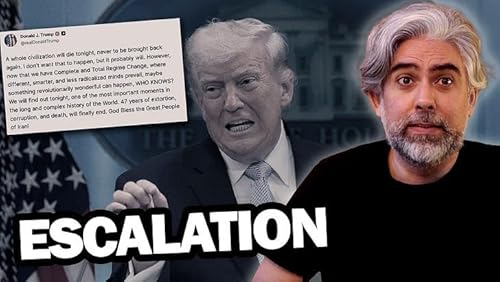
  • Trump Threatens Iran's "Whole Civilization." DHS Shutdown Winners and Losers (With Kirk Bado)
    Apr 7 2026

    Trump’s borderline-genocidal threats towards Iran from Tuesday morning are no doubt unsettling — and depending on whether this war keeps escalating after this episode is published, “unsettling” could be an understatement. The idea that civilization might be over feels hyperbolic, but it captures the uncertainty of the moment. We are sitting here waiting on a deadline tied to Iran, and even before anything happens, the rhetoric coming from Donald Trump is already at a level that feels historically aggressive.

    Honestly, I don’t know how else to process Trump’s post other than to take it seriously on its face. Presidents have said strong things before, but that kind of language feels different. It isn’t just tough talk or positioning. We’re talking about raising the stakes in a way that makes everything else around it feel more volatile. Even if it is meant as leverage, it is the kind of leverage that can spiral if it is misunderstood or taken literally.

    Part of me thinks that wording did not come out of nowhere. There was that open letter from the Iranian president talking about their country as one of the oldest continuous civilizations in history, and it feels like Trump is almost mirroring that language in a much more threatening way. That tracks with how he communicates. He tends to grab onto a phrase and then amplify it into something louder and more confrontational. But when the subject is this serious, that amplification hits differently.

    Politics Politics Politics is a reader-supported publication. To receive new posts and support my work, consider becoming a free or paid subscriber.

    What really complicates things for me is the question of who actually speaks for Iran right now. Even if there are people inside the government who want to negotiate or deescalate, it isn’t clear they have control over the parts of the system that are actively carrying out military actions. The Revolutionary Guard seems to operate with its own momentum, and there have already been examples where official statements from leadership did not match what was happening on the ground. That makes any potential deal feel shaky before it even starts.

    At the same time, there are signals that nobody really wants this to go all the way. Regional players like Saudi Arabia and Israel seem to prefer a scenario where enough damage is done to force a change in behavior without triggering total collapse. The idea is to hit hard enough that the current path is no longer viable, but not so hard that everything spirals into something uncontrollable. That’s a very narrow lane to try to stay in, especially when the rhetoric is this intense.

    Then there’s Trump himself, and I just keep coming back to the sense that he wants out. He talks about bringing people home with a win, but also hints at more aggressive options that would be far more complicated in reality. There is always that tension between the dealmaker instinct and the willingness to escalate. Right now it feels like both are present at the same time, and it’s anything but clear which one is going to win out.

    So I end up sitting with a lot of uncertainty, like a lot of people seem to have right now. The timeline suggests something is supposed to happen soon, but these situations have a way of stretching out or changing shape at the last minute. When the conversation ends on a line like an entire civilization potentially disappearing, it leaves me in a place where the only honest answer is that we are going to find out in real time what any of this actually means.

    Chapters

    00:00:00 - Intro

    00:02:19 - Trump’s Escalating Threats on Iran

    00:16:00 - Kirk Bado on the Winners and Losers of the DHS Shutdown

    00:40:02 - Update and Sanctuary City Airports

    00:43:24 - Bill Gates

    00:45:34 - Kalshi

    00:49:53 - Interview with Kirk Bado, con’t.

    01:16:42 - Wrap-up


    This is a public episode. If you'd like to discuss this with other subscribers or get access to bonus episodes, visit www.politicspoliticspolitics.com/subscribe
    Show more Show less
    1 hr and 19 mins
  • Pam Bondi OUT as Attorney General. How Memes are Impacting the Iran War (with Jason Levin)
    Apr 2 2026

    Pam Bondi is out as attorney general, and even though the official line is that she is moving on to something else, it really feels like a firing that had been building for a while. This is the first moment in this version of the administration where it feels less controlled and more like the old pattern, where someone becomes a liability and is shown the door.

    Looking back at her tenure, it’s hard for me to see it as anything other than turbulent from the beginning. She came in aggressive, especially on the Epstein files, making big public claims about what she had and what was coming. That created expectations that were never met, and when the follow through did not match the buildup, it turned into a credibility problem that never really went away. Once that narrative took hold, it felt like everything else she did was judged through that lens.

    The bigger issue seems to have been execution. There was clearly an effort to go after people seen as political adversaries, but the cases kept falling apart. Whether you think those targets were justified or not, the reality is that they did not hold up in court. That points less to ideology and more to process, and from what I can tell, there were real concerns inside legal circles that the work coming out of her office as AG just was not up to the typical standard.

    Politics Politics Politics is a reader-supported publication. To receive new posts and support my work, consider becoming a free or paid subscriber.

    At the same time, there’s the performative side of the job, and that might’ve been worse. This administration expects its officials to be fighters in the Trump mold, and not everyone can pull that off. When she tried to lean into that style — especially in hearings — it often came off as forced or awkward. That matters more than it probably should, because presentation is a big part of how this White House measures effectiveness.

    What makes this moment stand out to me is how it fits into the broader mood inside the administration. There are signs of tension, more shakeups, and a general sense that things are not running smoothly. When firings start to happen in that environment, it is usually not just about one person. It is about an administration trying to correct course while dealing with political pressure, falling poll numbers, and a complicated international situation.

    There’s also a noticeable difference in how these exits are handled compared to the first Trump term. This time, there is less public trashing on the way out. Bondi is not being turned into a villain in the same way guys like Steve Bannon were. It feels more managed, at least on the surface, which suggests there is an effort to keep things from looking chaotic even when they are.

    In the end, I see Bondi’s departure as less about a single failure and more about a combination of missteps that added up over time. Big promises that did not land, legal efforts that did not stick, and a style that never quite fit the role all contributed. When you add that to an administration that is already under pressure, it becomes easier to understand why she is the one who ends up out.

    Chapters

    00:00:00 - Intro

    00:03:22 - Pam Bondi Out

    00:11:24 - Jason Levin on Memetic Warfare

    00:34:37 - Trump’s Primetime Iran Speech

    00:43:12 - DHS Funding and Mike Johnson

    00:44:59 - Hegseth and Gen. Randy George

    00:46:51 - Interview with Jason Levin, con’t.

    01:15:42 - Wrap-up


    This is a public episode. If you'd like to discuss this with other subscribers or get access to bonus episodes, visit www.politicspoliticspolitics.com/subscribe
    Show more Show less
    1 hr and 20 mins
  • Can Trump Summon Congress to DC? Why the Military Community is Rosy on Iran (with Riley Blanton)
    Mar 31 2026

    On the surface, the question of whether Donald Trump can actually force Congress back to Washington to deal with the DHS shutdown sounds simple and dramatic. The Senate is gone, the House is gone, and yet, the problem is sitting there unresolved. Trump, Mike Johnson, and some Republicans are saying they should come back and fix it. The reality is a lot less cinematic.

    Right now, the Senate is technically in session but only barely. They are holding what are called pro forma sessions, which is basically the minimum effort required to say they are still working. One senator shows up, gavels in, gavels out, and everyone else stays wherever they already are. That setup is not an accident. It is designed specifically so nobody has to come back and take uncomfortable votes, even if there is business that could be handled quickly.

    There is a constitutional argument floating around that Trump could intervene. Article II, Section 3 gives the president the authority to convene Congress on extraordinary occasions, and some legal interpretations say that power is fairly broad. At least on paper, that sounds like a path. If this is a crisis, then call them back and make them deal with it. But Congress has always pushed back hard on that idea because it cuts directly into their independence, and the courts have generally sided with Congress when it comes to controlling their own schedule.

    Politics Politics Politics is a reader-supported publication. To receive new posts and support my work, consider becoming a free or paid subscriber.

    That is why, in practical terms, I don’t think Trump can force anything here. Even if he tried, it would turn into a political and possibly legal fight that would take longer than the shutdown itself. The Senate is a body that moves when it wants to move, and it prides itself on being slow, deliberate, and resistant to pressure. That is a polite way of saying they are not going to be bullied into flying back to DC because the White House tells them to.

    What actually matters is not the Constitution, it is the pressure. If the situation gets bad enough, senators will come back because they have to, not because they are ordered to. The key variable here is not a legal memo, but TSA lines. If airports turn into a disaster heading into a major travel weekend — you know, like Easter — then the political heat spikes immediately. That is when you start to see movement, because now voters are directly affected in a way they cannot ignore.

    Trump seems to understand that, which is why he moved to get TSA agents paid through executive action. It’s not a long term fix, but it might be enough to keep things from melting down. If the lines stay manageable, the urgency fades, and Congress can ride out the recess without much consequence. If the lines explode and people start missing flights in large numbers, then suddenly everyone has a reason to get back on a plane to Washington.

    So in the end, this is less about whether Trump can bring Congress back and more about whether circumstances will force Congress to bring itself back. My guess is that if the immediate pressure stays low, they will stay exactly where they are: in Disney World. If it doesn’t, though — if the public starts feeling the pain in a visible way — then the same lawmakers who left town will find a way to suddenly return to town very quickly.

    Chapters

    * 00:00:00 - Intro

    * 00:03:32 - Can Trump Call Congress Back to DC?

    * 00:17:28 - Riley Blanton on Iran and the Military Community’s Response

    * 00:43:50 - Update

    * 00:44:13 - Gas Prices

    * 00:47:21 - Trump’s Poll Numbers

    * 00:51:57 - Birthright Citizenship

    * 00:57:30 - Interview with Riley Blanton, con’t.

    * 01:35:38 - Wrap-up


    This is a public episode. If you'd like to discuss this with other subscribers or get access to bonus episodes, visit www.politicspoliticspolitics.com/subscribe
    Show more Show less
    1 hr and 40 mins
  • This DHS Shutdown Isn't Ending Anytime Soon. Exploring the AI Framework (with Andy Beach)
    Mar 26 2026

    As I recorded this episode, the Department of Homeland Security has been unfunded for more than 40 days, and the consequences are no longer abstract. TSA lines are stretching into hours at major airports, and with spring break and Easter travel ramping up, the strain is only getting worse.

    What stands out to me is the timing. The Senate appears ready to leave town for a two-week recess without resolving the standoff. That means lawmakers are effectively betting that the disruption will not reach a breaking point while they are gone. I am not so sure that is a safe bet.

    At the center of the dispute is funding for ICE enforcement operations. Democrats see this as a winning political issue and are holding firm. Republicans, meanwhile, are warning that the visible fallout, especially at airports, could become a liability for everyone involved.

    I keep coming back to one scenario that still feels unlikely but no longer impossible. If staffing shortages hit a critical level, you could see airport operations significantly disrupted or even halted. It would likely take something that dramatic to force lawmakers back to Washington.

    Politics Politics Politics is a reader-supported publication. To receive new posts and support my work, consider becoming a free or paid subscriber.

    From where I sit, Democrats are doubling down on an issue they believe energizes their base. But there is a risk in focusing on something that is not dominating headlines in the present moment.

    TSA delays are happening right now. This is a present problem, not something abstract, and ICE policy debates are not leading the news cycle in the same way. I also think leadership dynamics are playing a role. Chuck Schumer appears to be navigating pressure from within his own party, especially during primary season. There is a real possibility that he is waiting for public sentiment, including among Democratic voters, to shift enough to justify a compromise.

    At some point, though, there is usually a moment where a deal becomes the only viable option. The question is how much disruption it will take to get there.

    Donald Trump is expected to step in with an executive action aimed at addressing the TSA situation. The details are still unclear, but one possibility involves reallocating funds to keep operations running.

    That underscores a broader dynamic. Republicans increasingly see the shutdown as politically risky, while also betting that Democrats will not agree to a broader funding deal. The White House, for its part, continues to argue that fully funding DHS is the simplest solution.

    From my perspective, any executive fix is likely temporary. The underlying political fight is not going away.

    Chapters

    00:00 - Intro

    02:47 - DHS Shutdown

    13:05 - Ruy Teixeira, The Liberal Patriot, and Update

    19:18 - Iran

    22:01 - Voter ID

    23:56 - Anthropic and the Pentagon

    27:09 - AI Framework with Andy Beach

    56:12 - Wrap-up


    This is a public episode. If you'd like to discuss this with other subscribers or get access to bonus episodes, visit www.politicspoliticspolitics.com/subscribe
    Show more Show less
    59 mins
  • Is This the Path to Reopening DHS? The DC Gossip Outlet You Must Follow (with Juliegrace Brufke)
    Mar 24 2026

    The push to resolve the Department of Homeland Security shutdown through reconciliation is running into a hard reality in the Senate. What looks like a procedural workaround is, in practice, a much narrower path than many Republicans are publicly suggesting.

    At first glance, the strategy sounds clean. Fund most of DHS through a bipartisan deal, then use reconciliation to push through the rest, specifically ICE funding and pieces of the SAVE Act. No 60-vote threshold. No Democratic buy-in required. Problem solved.

    But the deeper I look at it, the less I think that path actually works.

    Politics Politics Politics is a reader-supported publication. To receive new posts and support my work, consider becoming a free or paid subscriber.

    The issue is the Byrd Rule, which is the guardrail on reconciliation. If it is not directly tied to the budget, meaning spending or revenue, it does not survive. And while ICE funding clearly qualifies, voter ID requirements and proof of citizenship mandates do not neatly fit into that category.

    That is why there is so little real enthusiasm behind the scenes for this plan. Publicly, it sounds like leverage. Privately, it looks like a stretch.

    From Trump’s perspective, the calculation is straightforward. He wants the SAVE Act, and he wants it tied to reopening DHS. That is the leverage. If Republicans split the two, they lose their biggest bargaining chip.

    That is why he initially rejected the idea of funding DHS first and handling ICE later. It weakens the negotiating position and turns a must-pass moment into a maybe-pass later.

    But the pressure is building. TSA lines are growing. The shutdown is visible. And some Republicans want to move on, not because they think they are losing politically, but because this fight is burning time they need for other priorities.

    A Theoretical Workaround

    There is, at least in theory, a way to thread this needle.

    If Republicans paired voter ID requirements with federal funding to provide free identification and proof of citizenship, you could argue that the policy has a direct budgetary impact. That would be the hook to survive reconciliation under the Byrd Rule.

    It would also undercut one of the central Democratic arguments, that voter ID laws function as a poll tax. If the IDs are free, that argument becomes harder to sustain.

    But even then, this is not a slam dunk. The Senate parliamentarian has wide discretion, and reconciliation rules have been stretched before, but not without limits.

    So where does that leave things?

    In my view, reconciliation is less of a solution and more of a talking point right now. It gives Republicans a way to signal that they have a plan to get everything they want. But the actual mechanics of the Senate make that plan far more difficult to execute than it sounds.

    Which means we are likely headed back to the same place most shutdown fights end: a negotiated deal that neither side fully likes, followed by both sides claiming victory.

    Because for all the talk of procedural maneuvers and legislative strategy, the simplest truth still applies.

    At some point, the government has to reopen.

    Chapters

    00:00:00 - Intro

    00:02:00 - DHS, SAVE Act, and Reconciliation

    00:14:05 - Oklahoma Senate Seat

    00:15:50 - Iran War Negotiations

    00:23:53 - Georgia’s Daylight Saving Time Bill

    00:26:10 - Interview with Juliegrace Brufke

    01:01:14 - Wrap-up


    This is a public episode. If you'd like to discuss this with other subscribers or get access to bonus episodes, visit www.politicspoliticspolitics.com/subscribe
    Show more Show less
    1 hr and 4 mins