Politics Politics Politics Podcast By Justin Robert Young cover art

Politics Politics Politics

Politics Politics Politics

By: Justin Robert Young
Listen for free

Unbiased political analysis the way you wish still existed. Justin Robert Young isn't here to tell you what to think, he's here to tell you who is going to win and why.

www.politicspoliticspolitics.comJustin Robert Young
Politics & Government World
Episodes
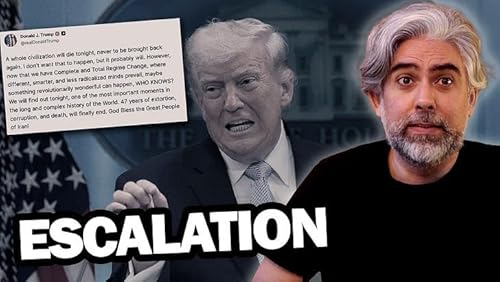
  • Trump Threatens Iran's "Whole Civilization." DHS Shutdown Winners and Losers (With Kirk Bado)
    Apr 7 2026

    Trump’s borderline-genocidal threats towards Iran from Tuesday morning are no doubt unsettling — and depending on whether this war keeps escalating after this episode is published, “unsettling” could be an understatement. The idea that civilization might be over feels hyperbolic, but it captures the uncertainty of the moment. We are sitting here waiting on a deadline tied to Iran, and even before anything happens, the rhetoric coming from Donald Trump is already at a level that feels historically aggressive.

    Honestly, I don’t know how else to process Trump’s post other than to take it seriously on its face. Presidents have said strong things before, but that kind of language feels different. It isn’t just tough talk or positioning. We’re talking about raising the stakes in a way that makes everything else around it feel more volatile. Even if it is meant as leverage, it is the kind of leverage that can spiral if it is misunderstood or taken literally.

    Part of me thinks that wording did not come out of nowhere. There was that open letter from the Iranian president talking about their country as one of the oldest continuous civilizations in history, and it feels like Trump is almost mirroring that language in a much more threatening way. That tracks with how he communicates. He tends to grab onto a phrase and then amplify it into something louder and more confrontational. But when the subject is this serious, that amplification hits differently.

    Politics Politics Politics is a reader-supported publication. To receive new posts and support my work, consider becoming a free or paid subscriber.

    What really complicates things for me is the question of who actually speaks for Iran right now. Even if there are people inside the government who want to negotiate or deescalate, it isn’t clear they have control over the parts of the system that are actively carrying out military actions. The Revolutionary Guard seems to operate with its own momentum, and there have already been examples where official statements from leadership did not match what was happening on the ground. That makes any potential deal feel shaky before it even starts.

    At the same time, there are signals that nobody really wants this to go all the way. Regional players like Saudi Arabia and Israel seem to prefer a scenario where enough damage is done to force a change in behavior without triggering total collapse. The idea is to hit hard enough that the current path is no longer viable, but not so hard that everything spirals into something uncontrollable. That’s a very narrow lane to try to stay in, especially when the rhetoric is this intense.

    Then there’s Trump himself, and I just keep coming back to the sense that he wants out. He talks about bringing people home with a win, but also hints at more aggressive options that would be far more complicated in reality. There is always that tension between the dealmaker instinct and the willingness to escalate. Right now it feels like both are present at the same time, and it’s anything but clear which one is going to win out.

    So I end up sitting with a lot of uncertainty, like a lot of people seem to have right now. The timeline suggests something is supposed to happen soon, but these situations have a way of stretching out or changing shape at the last minute. When the conversation ends on a line like an entire civilization potentially disappearing, it leaves me in a place where the only honest answer is that we are going to find out in real time what any of this actually means.

    Chapters

    00:00:00 - Intro

    00:02:19 - Trump’s Escalating Threats on Iran

    00:16:00 - Kirk Bado on the Winners and Losers of the DHS Shutdown

    00:40:02 - Update and Sanctuary City Airports

    00:43:24 - Bill Gates

    00:45:34 - Kalshi

    00:49:53 - Interview with Kirk Bado, con’t.

    01:16:42 - Wrap-up


    This is a public episode. If you'd like to discuss this with other subscribers or get access to bonus episodes, visit www.politicspoliticspolitics.com/subscribe
    Show more Show less
    1 hr and 19 mins
  • Pam Bondi OUT as Attorney General. How Memes are Impacting the Iran War (with Jason Levin)
    Apr 2 2026

    Pam Bondi is out as attorney general, and even though the official line is that she is moving on to something else, it really feels like a firing that had been building for a while. This is the first moment in this version of the administration where it feels less controlled and more like the old pattern, where someone becomes a liability and is shown the door.

    Looking back at her tenure, it’s hard for me to see it as anything other than turbulent from the beginning. She came in aggressive, especially on the Epstein files, making big public claims about what she had and what was coming. That created expectations that were never met, and when the follow through did not match the buildup, it turned into a credibility problem that never really went away. Once that narrative took hold, it felt like everything else she did was judged through that lens.

    The bigger issue seems to have been execution. There was clearly an effort to go after people seen as political adversaries, but the cases kept falling apart. Whether you think those targets were justified or not, the reality is that they did not hold up in court. That points less to ideology and more to process, and from what I can tell, there were real concerns inside legal circles that the work coming out of her office as AG just was not up to the typical standard.

    Politics Politics Politics is a reader-supported publication. To receive new posts and support my work, consider becoming a free or paid subscriber.

    At the same time, there’s the performative side of the job, and that might’ve been worse. This administration expects its officials to be fighters in the Trump mold, and not everyone can pull that off. When she tried to lean into that style — especially in hearings — it often came off as forced or awkward. That matters more than it probably should, because presentation is a big part of how this White House measures effectiveness.

    What makes this moment stand out to me is how it fits into the broader mood inside the administration. There are signs of tension, more shakeups, and a general sense that things are not running smoothly. When firings start to happen in that environment, it is usually not just about one person. It is about an administration trying to correct course while dealing with political pressure, falling poll numbers, and a complicated international situation.

    There’s also a noticeable difference in how these exits are handled compared to the first Trump term. This time, there is less public trashing on the way out. Bondi is not being turned into a villain in the same way guys like Steve Bannon were. It feels more managed, at least on the surface, which suggests there is an effort to keep things from looking chaotic even when they are.

    In the end, I see Bondi’s departure as less about a single failure and more about a combination of missteps that added up over time. Big promises that did not land, legal efforts that did not stick, and a style that never quite fit the role all contributed. When you add that to an administration that is already under pressure, it becomes easier to understand why she is the one who ends up out.

    Chapters

    00:00:00 - Intro

    00:03:22 - Pam Bondi Out

    00:11:24 - Jason Levin on Memetic Warfare

    00:34:37 - Trump’s Primetime Iran Speech

    00:43:12 - DHS Funding and Mike Johnson

    00:44:59 - Hegseth and Gen. Randy George

    00:46:51 - Interview with Jason Levin, con’t.

    01:15:42 - Wrap-up


    This is a public episode. If you'd like to discuss this with other subscribers or get access to bonus episodes, visit www.politicspoliticspolitics.com/subscribe
    Show more Show less
    1 hr and 20 mins
  • Can Trump Summon Congress to DC? Why the Military Community is Rosy on Iran (with Riley Blanton)
    Mar 31 2026

    On the surface, the question of whether Donald Trump can actually force Congress back to Washington to deal with the DHS shutdown sounds simple and dramatic. The Senate is gone, the House is gone, and yet, the problem is sitting there unresolved. Trump, Mike Johnson, and some Republicans are saying they should come back and fix it. The reality is a lot less cinematic.

    Right now, the Senate is technically in session but only barely. They are holding what are called pro forma sessions, which is basically the minimum effort required to say they are still working. One senator shows up, gavels in, gavels out, and everyone else stays wherever they already are. That setup is not an accident. It is designed specifically so nobody has to come back and take uncomfortable votes, even if there is business that could be handled quickly.

    There is a constitutional argument floating around that Trump could intervene. Article II, Section 3 gives the president the authority to convene Congress on extraordinary occasions, and some legal interpretations say that power is fairly broad. At least on paper, that sounds like a path. If this is a crisis, then call them back and make them deal with it. But Congress has always pushed back hard on that idea because it cuts directly into their independence, and the courts have generally sided with Congress when it comes to controlling their own schedule.

    Politics Politics Politics is a reader-supported publication. To receive new posts and support my work, consider becoming a free or paid subscriber.

    That is why, in practical terms, I don’t think Trump can force anything here. Even if he tried, it would turn into a political and possibly legal fight that would take longer than the shutdown itself. The Senate is a body that moves when it wants to move, and it prides itself on being slow, deliberate, and resistant to pressure. That is a polite way of saying they are not going to be bullied into flying back to DC because the White House tells them to.

    What actually matters is not the Constitution, it is the pressure. If the situation gets bad enough, senators will come back because they have to, not because they are ordered to. The key variable here is not a legal memo, but TSA lines. If airports turn into a disaster heading into a major travel weekend — you know, like Easter — then the political heat spikes immediately. That is when you start to see movement, because now voters are directly affected in a way they cannot ignore.

    Trump seems to understand that, which is why he moved to get TSA agents paid through executive action. It’s not a long term fix, but it might be enough to keep things from melting down. If the lines stay manageable, the urgency fades, and Congress can ride out the recess without much consequence. If the lines explode and people start missing flights in large numbers, then suddenly everyone has a reason to get back on a plane to Washington.

    So in the end, this is less about whether Trump can bring Congress back and more about whether circumstances will force Congress to bring itself back. My guess is that if the immediate pressure stays low, they will stay exactly where they are: in Disney World. If it doesn’t, though — if the public starts feeling the pain in a visible way — then the same lawmakers who left town will find a way to suddenly return to town very quickly.

    Chapters

    * 00:00:00 - Intro

    * 00:03:32 - Can Trump Call Congress Back to DC?

    * 00:17:28 - Riley Blanton on Iran and the Military Community’s Response

    * 00:43:50 - Update

    * 00:44:13 - Gas Prices

    * 00:47:21 - Trump’s Poll Numbers

    * 00:51:57 - Birthright Citizenship

    * 00:57:30 - Interview with Riley Blanton, con’t.

    * 01:35:38 - Wrap-up


    This is a public episode. If you'd like to discuss this with other subscribers or get access to bonus episodes, visit www.politicspoliticspolitics.com/subscribe
    Show more Show less
    1 hr and 40 mins
All stars
Most relevant
Big fan of your show for a while and i hope youre brand of analysis and interviews finds a home here.

Welcome to Audible

Something went wrong. Please try again in a few minutes.