• Case 017: The Forgotten Suspect Plantaris Strain
    Apr 16 2026

    Case 017: The Forgotten Suspect — Plantaris Strain

    This case rarely gets solved on the first attempt. The runner feels a sudden snap in the back of the calf — sharp, unexpected, and unmistakable. It feels like something serious. The kind of moment that stops you mid-stride. From there, the story branches: Achilles? Calf tear? Something more sinister? The answers vary depending on who you ask. But one name rarely makes the list.

    In this episode of The Foot Detective, we open the file on the Plantaris Strain — the overlooked injury that sits quietly between the bigger players and takes the blame for confusion more than anything else. We follow the clues through sudden explosive loading, posterior calf pain, swelling that mimics more familiar injuries, and the diagnostic grey zone that often leads to missed or delayed identification.

    This is not a story about the strongest muscle in the calf. It is a story about the one nobody thinks to check — and the consequences of that oversight. We explore how plantaris injuries masquerade as gastrocnemius strains or Achilles issues, why imaging often becomes the deciding factor, and how misdiagnosis can stretch recovery far longer than it needs to be.

    Because sometimes the injury isn’t hidden. It’s just been ignored.

    Feet don’t lie. I just follow the clues.

    Show more Show less
    6 mins
  • Case 016: The Cushion Job
    Apr 15 2026

    Case 016: The Cushion Job — Heel Fat Pad Syndrome

    This case is easy to misread. The runner reports a deep, bruised ache right in the centre of the heel — as if they are landing on a stone that never moves. They’ve often already been told it is plantar fasciitis. They’ve stretched, rolled, loaded, maybe even worn a night splint. And still the pain stays exactly where it started. Because this is not a fascia problem. It is a cushioning problem.

    In this episode of The Foot Detective, we open the file on Heel Fat Pad Syndrome — the quiet failure of one of the foot’s most overlooked shock absorbers. We follow the clues through central heel pain, years of impact loading, thinning fat pad tissue, hard running surfaces, minimal footwear, and the common mistake of treating the wrong structure for months at a time.

    This is not a story about inflammation at the edge of the heel. It is a story about what happens when the calcaneus loses the protective padding that once stood between bone and ground. We look at how to distinguish fat pad pain from plantar fasciitis, why age, mileage, surface, and shoe choice all matter, and what management actually helps when the issue is not tightness — but lost protection.

    Because sometimes the heel is not asking to be stretched. Sometimes it is asking for its cushion back.

    Feet don’t lie. I just follow the clues.

    Show more Show less
    6 mins
  • Case 015: The Crooked Angle Hallux Valgus (Bunion)
    Apr 15 2026

    Case 015: The Crooked Angle — Hallux Valgus (Bunion)

    This case rarely begins as an injury. It begins as something the runner has simply learned to live with — a toe drifting outward, a bony prominence rubbing against the shoe, a quiet discomfort managed with wider footwear and tolerance. But over time, what looks like a cosmetic nuisance starts changing the way the foot works. Push-off shifts. Load moves elsewhere. And the consequences start spreading beyond the big toe itself.

    In this episode of The Foot Detective, we open the file on Hallux Valgus — the progressive deformity better known as a bunion. We follow the clues through inherited foot shape, narrow toe boxes, first ray instability, restricted first MTP motion, and the compensations that send force into the lesser metatarsals when the hallux can no longer do its share.

    This is not just a story about a toe pointing the wrong way. It is a story about what happens when the foot’s main lever for propulsion begins to fail under load. We look at how hallux valgus changes running mechanics, why some runners cope for years while others begin to unravel, and what conservative management can still achieve before the joint becomes too stiff, too painful, or too structurally changed.

    Because sometimes the issue is not the bump itself. It is the way the whole foot starts working around it.

    Feet don’t lie. I just follow the clues.

    Show more Show less
    6 mins
  • Case 014 - The Overreach
    Apr 15 2026

    Case 014: The Reach — Overstriding

    This case rarely arrives under one name. It turns up as shin pain, then anterior knee pain, then hip flexor tightness, then back to the shin again. Each flare-up gets treated as its own problem. Each tissue gets attention. And yet the pattern keeps returning. Because the real issue was never just the tissue. It was the way the runner was landing.

    In this episode of The Foot Detective, we open the file on Overstriding — the gait pattern where the foot lands too far ahead of the body’s centre of mass, creating a braking force that travels up the chain with every step. We follow the clues through low cadence, heel-ahead-of-hip contact, poor forward lean, limited hip drive, and footwear choices that can reinforce the problem.

    This is not a story about one injured structure. It is a story about a movement pattern that spreads load predictably across the shin, knee, and hip until something gives. We look at why recurring lower-limb injuries often share the same mechanical root, how to spot overstriding on gait analysis, and what actually changes it — from cadence work and hip loading to smarter shoe decisions.

    Because sometimes the body is not breaking in random places. Sometimes the stride is creating the same collision over and over again.

    Feet don’t lie. I just follow the clues.

    Show more Show less
    6 mins
  • Case 013 - Death By Distance - Overtraining Syndrome
    Apr 13 2026

    Case 013: Death by Distance — Cumulative Fatigue & Overtraining Syndrome

    This case doesn’t break the runner all at once. It wears them down slowly. The pace stops improving. Easy runs begin to feel like work. Recovery stretches from hours into days. The instinct is to push harder, add more, and chase fitness with even greater effort. But sometimes the problem isn’t a lack of discipline. It’s a body that has been asked for too much, for too long.

    In this episode of The Foot Detective, we open the file on Cumulative Fatigue and Overtraining Syndrome — the quiet collapse that happens when training load keeps rising but recovery cannot keep pace. We follow the clues through relentless mileage, missing rest days, poor sleep, low energy availability, rising resting heart rate, blunted motivation, and a system that is no longer adapting.

    This is not the story of a runner who went soft. It is the story of a runner whose physiology stopped absorbing the work. We explore how to spot the warning signs, how to separate normal training fatigue from systemic overload, and why the answer is often not more grit — but less stimulus, better fuelling, and a smarter structure.

    Because sometimes the body doesn’t fail from one dramatic moment. Sometimes it just gets buried, one mile at a time.

    Show more Show less
    6 mins
  • Case 012: The Phantom Pain Maranoia
    Mar 12 2026

    Case 012: The Phantom Pain — Maranoia

    This case doesn’t begin with a breakdown. It begins with doubt. Training is going well, the plan is on track, and the race is close — but suddenly every click, twinge, ache, and heavy stride starts to feel loaded with meaning. A knee noise becomes a threat. A fleeting hamstring pull becomes a warning. A body that has carried months of work starts to feel suspicious.

    In this episode of The Foot Detective, we open the file on Maranoia — that pre-race state where hypervigilance, anxiety, and investment turn normal training sensations into potential disaster. We trace the clues through taper week heaviness, poor sleep, social media-fuelled fear, and the pressure that builds when a race becomes more than a race.

    This is not about imaginary pain. The sensations are real. But the interpretation can become distorted. We look at how to separate signal from noise, how to spot the difference between true pathology and pre-race catastrophising, and how to get runners to the start line with a calmer mind and a body they can trust.

    Because sometimes the biggest threat before race day isn’t the injury. It’s the story the runner starts telling themselves about it.

    Show more Show less
    6 mins
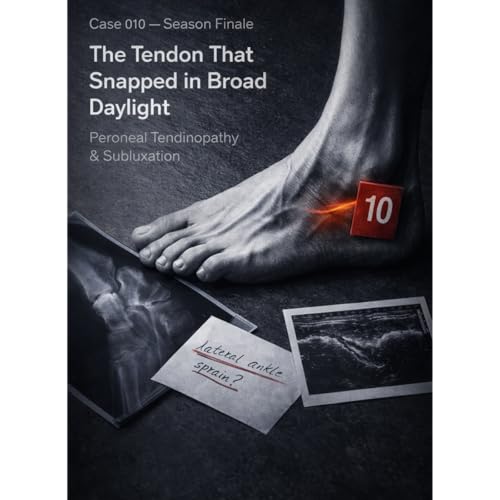
  • Case 010 - The Season Finale - The Tendon That Snapped in Broad Daylight
    Mar 6 2026

    They'll call it a lateral ankle sprain. They'll ice it, tape it, and be back four weeks later with the same problem — because a peroneal tendon injury doesn't follow the same rules.

    The outer ankle is a crime scene with multiple possible perpetrators. In this episode, we work through all five: the sprain that brought the tendons down with it, the overuse pattern built on cambered roads, the shallow groove that lets the tendon escape with every step, the longitudinal split tear that standard MRI misses, and the high-arched foot that loaded the predisposition until something gave way.

    We cover how to map peroneal pain away from ligament pain, the one question most clinicians never ask, why dynamic ultrasound catches what static imaging misses, and how the management pathway splits entirely depending on whether you're dealing with tendinopathy, a tear, or a tendon that's regularly leaving its groove.

    This one's for every runner whose ankle sprain never quite resolved.

    Show more Show less
    6 mins
  • case 009 - The Fracture That Wasn't on the X-Ray
    Mar 6 2026

    A deep midfoot ache. Weeks of it. A normal X-ray. A green light to keep training. And then — a complete fracture.

    The navicular stress fracture is running medicine's most deceptive case. The bone sits at the apex of the medial arch, absorbs enormous compressive force at push-off, and carries a blood supply too poor to tolerate a missed diagnosis. Get it wrong and a stress reaction becomes a fracture. Get that wrong and you're in surgery.

    In this episode, we work through the five suspects — athlete profile, foot geometry, training errors, RED-S, and the early warning signal that runners keep training through. We cover the N-spot, the hop test, and why a normal X-ray is not reassurance. We explain why CT and MRI are non-negotiable, why immediate removal from running is the only appropriate response to clinical suspicion, and how fracture grade determines everything that follows.

    This one's for every runner who was told their X-ray was fine and went back to training anyway.

    Show more Show less
    7 mins