

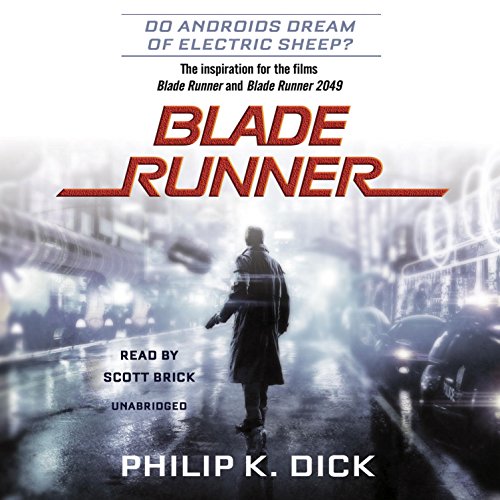
Blade Runner
Originally published as Do Androids Dream of Electric Sheep?
Failed to add items
Sorry, we are unable to add the item because your shopping cart is already at capacity.
Add to Cart failed.
Please try again later
Add to Wish List failed.
Please try again later
Remove from wishlist failed.
Please try again later
Adding to library failed
Please try again
Follow podcast failed
Please try again
Unfollow podcast failed
Please try again
Audible Standard 30-day free trial
Select 1 audiobook a month from our entire collection of titles.
Yours as long as you’re a member.
Get unlimited access to bingeable podcasts.
Standard auto renews for $8.99 a month after 30 days. Cancel anytime.

Blade Runner
Narrated by:
Scott Brick
Buy for $15.73
-
Narrated by:
-
Scott Brick
-
By:
-
Philip K. Dick
By 2021, the World War has killed millions, driving entire species into extinction and sending mankind off-planet. Those who remain covet any living creature, and for people who can’t afford one, companies build incredibly realistic simulacra: horses, birds, cats, sheep. They’ve even built humans. Immigrants to Mars receive androids so sophisticated they are indistinguishable from true men or women. Fearful of the havoc these artificial humans can wreak, the government bans them from Earth. Driven into hiding, unauthorized androids live among human beings, undetected. Rick Deckard, an officially sanctioned bounty hunter, is commissioned to find rogue androids and “retire” them. But when cornered, androids fight back—with lethal force.
Praise for Philip K. Dick
“[Philip K. Dick] sees all the sparkling—and terrifying—possibilities . . . that other authors shy away from.”—Rolling Stone
“A kind of pulp-fiction Kafka, a prophet.”—The New York Times©1968 Philip K. Dick; (P)2007 Random House, Inc. Random House Audio, a division of Random House, Inc.
Listeners also enjoyed...






Editorial review
Editorial review
By Emily Martin
IF YOU READ ONLY ONE ANDROID NOVEL IN YOUR LIFETIME, IT SHOULD BE BLADE RUNNER
I have a poster of Ridley Scott's Blade Runner hanging up in my living room, but, like any self-respecting book person, before I'd seen the famous movie adaptation, I read Do Androids Dream of Electric Sheep? The first time I read Philip K. Dick's novel, straightforward but filled to the brim with invention and thought-provoking concepts, was for a science fiction class as an undergrad. At the time, I had no idea what "cyberpunk" meant, and I certainly didn't understand the difference between an android and a robot. But Do Androids Dream of Electric Sheep? opened up my eyes to how sci-fi could engage the imagination.
If you've seen Blade Runner and have read or listened to the novel it’s based on, then you know that the film is not exactly what one would call a "faithful" adaptation. In fact, when I teach this book and this film in my dystopian fiction courses, students are often disappointed in the movie after reading the book first. But I think both the movie and the film are essential parts of the sci-fi canon. Both works are in conversation with each other. And both have significant things to say about the meaning of life, what it means to feel emotions, and (most essentially) what it means to be human.
Simply put, science fiction would not be where it is today without the influence of Blade Runner. And yet the audiobook is more than just an important part of sci-fi history. It's actually an incredibly engrossing, edge-of-your-seat, unforgettable ride. The future world that Philip K. Dick paints for us in his novel is a bleak one, filled with desperate characters fighting to find meaning in a world that has left them behind. But it's also a world where humanity—including androids—fights to do so much more than just survive. They're fighting for a life that feels full. Just like the rest of us.
Continue reading Emily's review >
Featured Article: The top 100 classics of all time
Featured Article: The top 100 classics of all time
Before we whipped out our old high school syllabi and dug deep into our libraries to start selecting contenders for this list, we first had to answer the question, "How do we define a classic?" The answer isn’t as straightforward as you might guess, though there’s a lot to be said for the old adage, "You know it when you see it" (or, in this case, hear it). Of course, most critically, each of our picks had to be fabulous in audio. So dust off your aspirational listening list—we have some amazing additions you don’t want to miss.

People who viewed this also viewed...



On a near-future earth ravaged by the radioactive fallout of the last World War, the remnants of humanity who have stubbornly decided to stay (instead of emigrating to the off-world colonies) occasionally have to contend with androids--escapees from their lives as servants on the off-world colonies. Much of humanity has reached a state of relative peace thanks to a religion based on empathy (sympathizing and then identifying with another), but the androids lack empathy and are thus dangerous to other humans, so its up to bounty hunters like Rick Deckard to find out who is human and who is machine and "retire" the androids.
Phillip K. Dick's books often have wacky premises, but the reason readers and film producers keep coming back to his work is that he creates a compelling internal logic and structure of feeling for his characters to act within. Deckard comes to question how he defines his humanity and the perils/limits of empathy, for example. This book isn't action-based (although there is some of that), but really based around tense moments (and to Dick's credit, they are tense moments) where Deckard is having crisis of conscience or is questioning who is a real person, who is artificial, and what that distinction means. This led to several moments that put me on the edge of my seat. The ominous atmosphere of post-nuclear earth, the inhuman threat of the androids, and the other strange elements of the story come together to form a quirky but immersive atmosphere for Deckard's inner struggles with himself and outer struggle with the androids.
I would summarize Scott Bricks typical narrative style in two words: broody and languid. He draws out words and creates an almost hypnotic rolling effect with his voice that is enjoyable if you are in the mood for that. Brick doesn't read, he performs, but that performance may not be to everyone's taste (so do listen to the sample clip). Still, it fits well with this book: his almost melancholy narration highlights the gloom of post-nuclear Earth and the broodiness of the characters themselves.
Quirky, Ominous, Immersive
Something went wrong. Please try again in a few minutes.
The conversational flow was lost and it was choppy.
I only wish Harrison Ford read this one. The version of the movie where he narrated was the best one (to me anyway)
Dispite my dislike of the read I enjoyed the book very much. I read the hard cover version years ago and it was a nice refresher.
Love the book, disliked the read
Something went wrong. Please try again in a few minutes.
Great story, “dated” performance
Something went wrong. Please try again in a few minutes.
Overrated
Something went wrong. Please try again in a few minutes.
Good book, bad narrator
Something went wrong. Please try again in a few minutes.